


Inside Crafted Connections: first weeks of the residency
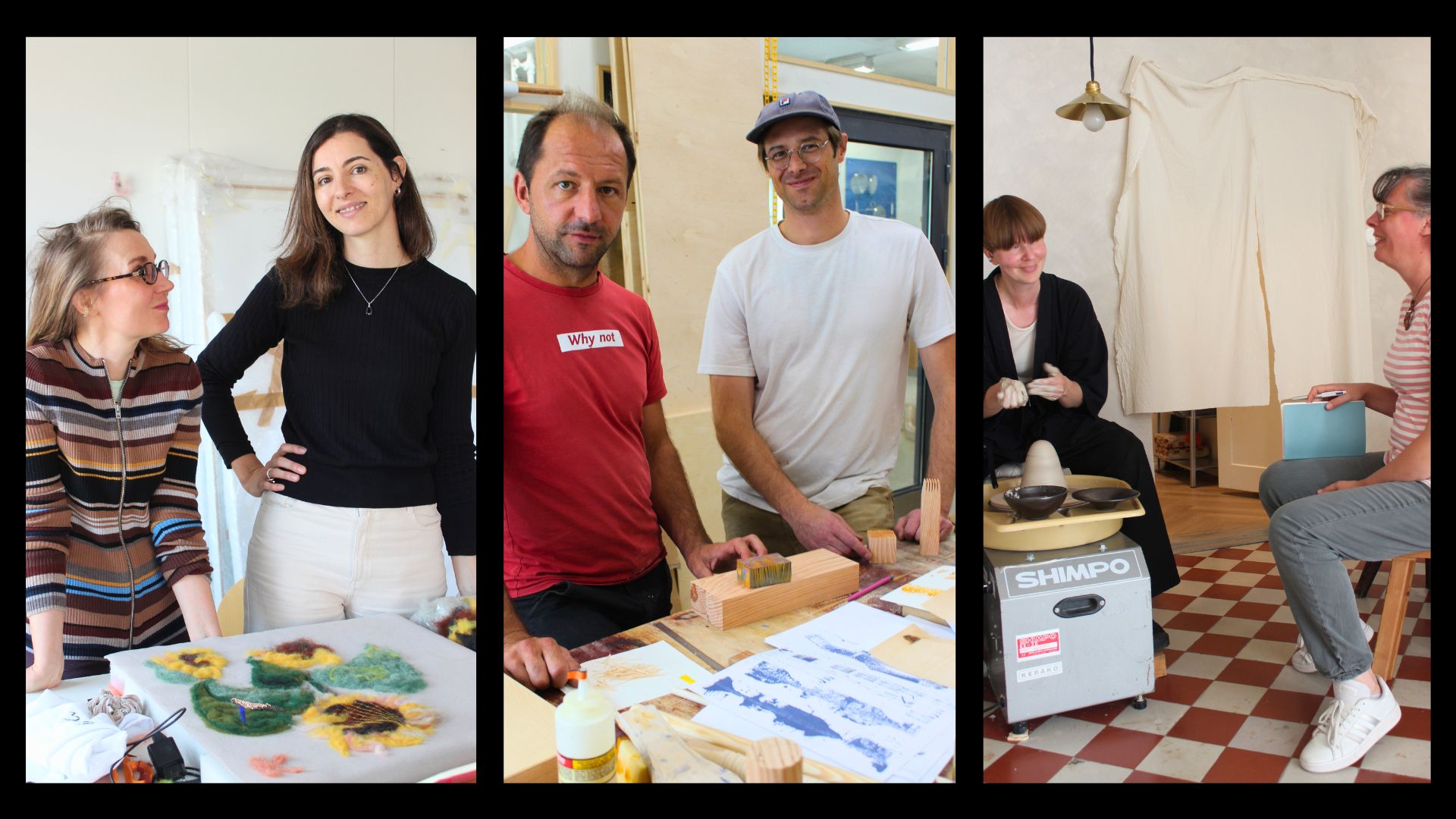
Just a few days before the opening of the Crafted Connections exhibition, here’s a sneak peek at how the process is taking shape for our three artist duos.
Cécile Gray & Hanna-Kaisa Korolainen: from contrast to harmony
For Hanna-Kaisa and Cécile, the starting point was an obvious contrast.
While both work with textiles, Hanna-Kaisa’s felt needling and tufting are almost the opposite of Cécile’s delicate structures made from golden metal wire. Their challenge, therefore, was not simply to bring two techniques together, but to develop a visual language that could make space for both.
Nature provided an important point of connection. The pair spent time drawing together in Hanna-Kaisa’s garden, looking at vegetation and flowers as a shared source of inspiration.
“At the end of the day, there’s a lot of geometry that can be found in plants”, Cécile explains.
This is where the idea of a colorful, garden-themed needle felting piece complemented by Cécile’s geometrical and light-attracting metal pattern came from.
Meanwhile the combination of the two artist’s styles may be surprising, they already see the possibility of meeting again for another exhibition or developing the work further if the current experiments succeed:
“(We could) at least come back together for another exhibition in the future. And if the works of this residency turn out good, we could perhaps propose them to a European Textile Biennal. There are a lot of them in many many different countries”, Hanna-Kaisa states.
Paul Flanders & Pierre-Henri Beyssac: Re-imagining the marquetery technique
For the woodworkers Paul and Pierre-Henri, the collaboration began with a different kind of spark: both wanted to work with the marquetery technique, in which Pierre-Henri is specialized, but the blades available at Paul’s workshop weren’t adapted to this decorative technique.
Historically, marquetry was described as “wood painting” where thin veneers of different species of wood were assembled to imitate brushstrokes, landscapes and light.
However, this French-Finnish duo decided to turn the original idea of “wood painting” inside out: they are designing their own, wooden tools—rollers, stamps, brushes and other implements—to create colour and patterns on veneer. The marked veneer will then be cut and incorporated into the marquetry itself, bringing the project back to marquetery’s initial idea.
The tools are therefore not merely means to an end: they become part of the pair’s attempt to develop a new visual language.
Visual language is something the duo has talked about a lot:
” [….] when you talk about painters, it’s often (based on) how hard they’ve pressed for or how much paint they take on or how thick it is that you can look at a painter and they have a signature way of painting. And particularly, when things become more automated or done by computer or machines, then there isn’t this mark anymore, they’re all identical”, Paul tells.
The residency has allowed both artists to discover the woodwork cultures of their respective countries. One of the discoveries that Paul has had while working with Pierre-Henri is the 400-hundred-year-old history of marquetery, bringing with it a set of know-how and rules, as well as Pierre-Henri’s more experimental style. For Pierre-Henri, it’s the Finnish wood that has been particularly interesting:
“In France, […] I’m working with a lot of different kinds of wood, from all over the world. (Here), we are working with what we’ve found in Finland. […] And I think it’s part of your culture in how you make your chairs, your own design. The nature can still be seen in the final products.”
Merileena Reunanen & Karelle Couturier: Permission to slow down
Ceramic artist Merileena and basketry artist Karelle found common ground almost immediately.
When Karelle first saw Merileena’s work online, she felt an immediate connection. She had previously travelled to Japan and developed an interest in Japanese techniques and materials, particularly the importance given to emptiness and space. Merileena recognised something similar in Karelle’s work: a shared interest in natural materials, calm and the creation of space for people to simply be.
The first objects are trays inspired partly by Japanese tea culture. The artists wanted to find a way to combine their crafts on something both practical and sculptural. The experiments include clay and bamboo, with the two materials being integrated into the same objects. Even during the exhibition at Stockmann, the audience will have a chance to sit down with Merileena for a cup of tea.
Besides the tea culture, Merileena is particularly interestesd in stones and their rounded, irregular forms. This led the duo towards the second part of their collaboration: a small village of nests, with birds and connecting structures.
“Even with this nest, it sort of started with the stones and the shape of the stones. I suggested that idea (of nests) to Karelle, also because my dad was cutting some wood at our summer home and then there was a lot of extra material. So I got this idea that there could be a really long stick ladder that leads to the nest, like all the way to the floor. And then Karelle suggested the ladders could go from one nest to another and that she could add the birds in there.”
Underneath the playfulness of the bird nests lies the same concern that brought them together in the first place: creating a peaceful space for the viewer.
What can be expected from the exhibition
Across the three collaborations, the same pattern keeps appearing: the artists are not simply combining techniques. They are exposing their working habits to another person’s way of thinking.
That is perhaps the real material of Crafted Connections.
The exhibition that will open for the Helsinki Design Week on August 27 will showcase the objects that survive this process—felt and metal, wood and marquetry, ceramics and basketry. But behind those finished pieces is another, less visible result: new methods, new relationships and the possibility that some of these temporary partnerships may continue long after the residency ends